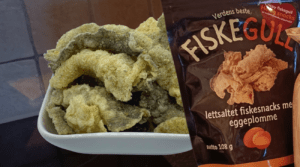
Natural omega-3 and collagen in fish skin – what do you really get?
Fish oil is marketed as “rich in omega-3 and collagen.” But what does that mean in practice? Where do the nutrients come from, what do they do in the body, and how much do you get from a bag of crispy fried salmon skin?
In this article, we take a closer look at omega-3 and collagen in fish skin – based on the research. Spoiler: It's more than just marketing, but less than a supplement.
What is omega-3, and why do we need it?
Omega-3s are essential polyunsaturated fatty acids that the body cannot produce itself – we must get them from food.
Three main types:
| Type | Source | Health effect |
|---|---|---|
| LAND | Plant sources (flaxseed, chia, walnuts) | Konverteres dårlig til EPA/DHA (<10%) |
| EPA | Fatty fish, seafood | Anti-inflammatory, heart health |
| DHA | Fatty fish, seafood | Brain, vision, fetal development |
Recommendations from the Norwegian Directorate of Health:
- Eat fish 2-3 times per week
- At least 200-300 g of fatty fish (salmon, mackerel, herring) per week
Documented effects (based on meta-analyses):
- Moderately reduces triglycerides and blood pressure
- Lower risk of cardiovascular disease
- Anti-inflammatory effect
Omega-3 in salmon skin
Salmon stores omega-3 in its fatty tissue – both in the fillet and the skin. When Fiskegull is made from salmon skin, EPA and DHA are included.
Fish meal (per 100 g):
- Fat: 46.4 g (of which polyunsaturated: 13.8 g)
- Protein: 40,3 g
- Carbs: 10.4 g
Omega-3 content:
Fiskegulla does not list the exact omega-3 amount on the label. Based on USDA data for salmon (100 g fresh salmon = approx. 2.3 g EPA+DHA), a 30 g serving of Fiskegulla probably makes a modest contribution to daily omega-3 intake – less than fresh fish or cod liver oil, but more than traditional snacks.
What is collagen – and what do you get?
Collagen is the body's most common protein, found in skin, tendons, cartilage and bones. Fish skin is mainly composed of type I collagen.
How does it work?
The body breaks down collagen into amino acids (glycine, proline, hydroxyproline) during digestion. These are used to build the body's own proteins – including new collagen.
Collagen in Fish Gold:
A significant portion of the 40.3 g protein per 100 g comes from collagen in the skin. (For comparison: 100 g of gelatin is almost pure collagen.)
What does the research say?
Omega-3 (strong evidence):
- American Heart Association (2020): Lowers triglycerides, moderate effect on heart health
- EFSA: Approved health claim for EPA/DHA and heart, vision, fetus
Collagen (more mixed):
- Hud: Proksch et al. (2014): 2.5-5 g collagen/day for 8 weeks improved skin elasticity in women
- Joint: Bello & Oesser (2006): Moderate pain relief in osteoarthritis
Brand: Studies often use supplements (5-15 g/day). A snack can help, but does not replace this.
Fish collagen: Slightly different amino acid profile than bovine collagen, but the body uses both equally.
What do you get from a serving of Fish Gold?
Per 100 g Fish Gold:
- Protein: 40.3 g (including collagen)
- Fat: 46.4 g (incl. omega-3)
- Carbs: 10.4 g
- Calories: 616 kcal
Per 30 g serving (typical snack):
- Protein: 12,1 g
- Fett: 13,9 g
- Carbs: 3.1 g
- Calories: 185 kcal
Realistic summary:
- Omega-3: Modest contribution – good for a snack, not a replacement for fish/cod liver oil
- Protein: Good source of collagen amino acids – supports overall protein needs
- Low-carb friendly snacks with marine nutrients
Compared to alternatives:
| Source | Omega-3 (EPA+DHA)* | Protein/100g | Form |
|---|---|---|---|
| Fish gold 30g | Moderate contribution** | 12,1 g | Crispy snack |
| Salmon 100g (fish) | ~2,3 g | 20 g | Dinner |
| Tran 1 ss (5 ml) | ~1,3 g | 0 g | Liquid |
| Gelatin 10g | 0 g | 8,5 g | Collagen |
*Data from USDA FoodData Central
**Exact amount varies with individual salmon and season
Why choose fish skin as a snack?
Fish meal does not provide “therapeutic doses” of omega-3 or collagen, but a natural contribution in a crispy, low-carb snack:
Advantages:
Protein + omega-3 + collagen in one bag. Better than empty calories from potato chips.
Use:
Friday snack, after training, travel snack or topping on salad.
Not a substitute for:
- Weekly fish intake (200-300 g oily fish)
- Dietary supplements for specific needs
Summary
Fiskegul salmon skin contains natural omega-3 and collagen from Norwegian salmon. One serving provides a good protein contribution with marine fatty acids – documented to be beneficial for the heart, inflammation and general health. The collagen contributes amino acids the body uses for its own maintenance.
Perfect as: Low-carb snack with a little extra nutrition. Not a supplement, but far better than regular chips.
Ready to test? Find Fish Gold in sea salt, paprika, wasabi or cranberry:
Buy Fish Gold here
Sources
- Directorate of Health – Dietary advice for the population
Official recommendations on fish intake and omega-3
https://www.helsedirektoratet.no/faglige-rad/kostradene-og-naeringsstoffer/kostrad-for-befolkningen - American Heart Association (2020)
“Omega-3 Polyunsaturated Fatty Acid (Fish Oil) Supplementation and the Prevention of Clinical Cardiovascular Disease”
Circulation. 2020;142:e366–e368
https://www.ahajournals.org/doi/10.1161/CIR.0000000000000874 - EFSA (European Food Safety Authority)
Scientific Opinion on the substantiation of health claims related to omega-3 fatty acids
https://www.efsa.europa.eu/ - Brenna, JT et al. (2009)
“α-Linolenic acid supplementation and conversion to n-3 long-chain polyunsaturated fatty acids in humans”
Prostaglandins, Leukotrienes and Essential Fatty Acids, 80(2-3), 85-91
https://pubmed.ncbi.nlm.nih.gov/19269799/ - USDA FoodData Central
Nutritional data for salmon, mackerel and other foods
https://fdc.nal.usda.gov/ - Ricard-Blum, S. (2011)
“The collagen family”
Cold Spring Harbor Perspectives in Biology, 3(1), a004978
https://pubmed.ncbi.nlm.nih.gov/21421911/ - Varani, J. et al. (2006)
“Decreased collagen production in chronologically aged skin”
American Journal of Pathology, 168(6), 1861-1868
https://pubmed.ncbi.nlm.nih.gov/16723701/ - Proksch, E. et al. (2014)
“Oral supplementation of specific collagen peptides has beneficial effects on human skin physiology”
Skin Pharmacology and Physiology, 27(1), 47-55
https://pubmed.ncbi.nlm.nih.gov/23949208/ - Bello, A.E. & Oesser, S. (2006)
“Collagen hydrolysate for the treatment of osteoarthritis and other joint disorders”
Current Medical Research and Opinion, 22(11), 2221-2232
https://pubmed.ncbi.nlm.nih.gov/17076983/ - Lim, Y. S. et al. (2019)
“Marine collagen as a promising biomaterial for biomedical applications”
Marine Drugs, 17(8), 467
https://pubmed.ncbi.nlm.nih.gov/31416268/
Disclaimer: This article is not medical advice. Fish meal is a food, not a dietary supplement or medicine. For health concerns, consult a doctor or nutritionist.
-
Sale!

Fish gold fish snacks with Red Paprika 108gr.
kr 51,30 – kr 7180,00Price range: kr 51,30 through kr 7180,00 excl. VAT Select options This product has multiple variants. The options may be chosen on the product page -
Sale!

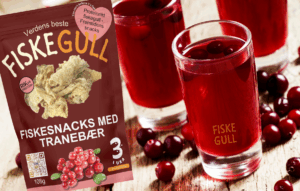
Fish gold fish snacks with cranberries 108gr.
kr 51,30 – kr 7180,00Price range: kr 51,30 through kr 7180,00 excl. VAT Select options This product has multiple variants. The options may be chosen on the product page -
Sale!

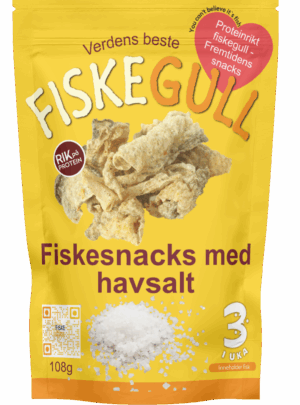
Fish gold fish snacks with sea salt 108gr.
kr 51,30 – kr 7180,00Price range: kr 51,30 through kr 7180,00 excl. VAT Select options This product has multiple variants. The options may be chosen on the product page -
Sale!

Fish gold fish snacks with Wasabi 108gr.
kr 51,30 – kr 7180,00Price range: kr 51,30 through kr 7180,00 excl. VAT Select options This product has multiple variants. The options may be chosen on the product page
FAQ: Natural Omega-3 and Collagen (Cod Fish Oil)
1) What do you mean by “natural Omega-3 and collagen”?
Fish gold is made from salmon skin. Salmon naturally contains omega-3 fatty acids, and fish skin naturally contains collagen (a protein found in connective tissue). When we say “natural,” we mean that this comes from the raw material – not as an added dietary supplement.
2) Is Fish Gold a dietary supplement?
No. Fish meal is a food/snack. The nutrient content comes from the raw material and the stated nutritional declaration.
3) What type of omega-3 are we talking about?
In seafood, omega-3s are typically the long-chain fatty acids EPA and DHA. The amount can vary between batches and varieties.
4) How much omega-3 do I get per serving?
It depends on the raw material, process and variant. If you want to communicate exact numbers (e.g. “X mg EPA/DHA”), it should be documented with analysis and stated in line with regulations for nutrition claims.
5) What is collagen – and why is it mentioned in Fiskegull?
Collagen is a structural protein found naturally in skin and connective tissue (including fish skin). Fish gold is made from salmon skin, and therefore collagen is a natural part of the raw material.
6) Is the “collagen” in Fiskegull the same as collagen supplements?
Not necessarily. Collagen supplements are often hydrolyzed collagen (peptides) with a specified dose. Fish meal is a food product where proteins (including collagen) are included as part of the raw material.
7) Can you promise an effect on skin, hair, joints or similar?
No. Fish gold is a snack, and we do not make any medical promises. If you wish to use health claims, they must be approved according to applicable regulations.
8) Is Fish Gold “healthy”?
"Healthy" depends on the overall diet. Fish flakes can be an option for those who want a crunchy snack with lots of protein from seafood. See the nutrition label and consider portion size.
9) Why is Fiskegull a good alternative to regular chips?
Many people choose Fiskegull because it is:
Crispy and "snackable"
Rich in protein (see nutrition declaration)
Based on seafood
An alternative for those who want something other than potato-based snacks
10) What ingredients are in Fish Gold?
The ingredient list varies between varieties (sea salt, red pepper, wasabi, cranberry, etc.). Always check the packaging for the latest ingredient list.
11) Does Fiskegull contain palm oil?
No, Fiskegull does not contain palm oil.
12) Is Fiskegull gluten-free?
Fish gold is labeled gluten-free. Always read the packaging for up-to-date information.
13) Is Fiskegull low carb or keto?
Many people use Fish Gold as a low-carb, keto-friendly snack option. Whether it's suitable for keto depends on how strict you are and how much you take per serving. Check the carbohydrate content on the package.
14) Where do the carbohydrates come from when it is fish skin?
Carbohydrates in the finished product typically come from starch/spices used in processing and seasoning – not from the fish skin itself.
15) How much protein is in Fish Gold?
The protein content is listed in the nutritional information on the packaging. It may vary between varieties and batches.
16) What about fat – is it “good fat”?
The fat profile is affected by the raw material and the oil/preparation used. Salmon contains naturally unsaturated fats, including omega-3. For details: see the nutritional declaration.
17) What allergens does Fiskegull contain?
Fish gold contains fish. Some varieties may also contain soy. Always check the allergen label on the packaging.
18) Can children eat Fish Gold?
Fish flakes are a food item. As with all snacks, it is recommended to take into account portion size and any allergies (fish/soy). For small children: be aware of the chewing/choking risk of crispy snacks.
19) Is Fish Gold safe to eat for pregnant women?
As a general rule, pregnant women can eat seafood, but individual considerations vary. For special needs or allergies: consult a healthcare professional. Always check the ingredient list and allergens.
20) Where is Fish Gold produced?
See the packaging for information about the manufacturer and origin. (If you wish, we can formulate a fixed, correct sentence based on what is written on the package.)
21) Is the raw material Norwegian?
This depends on raw material availability and documentation. If you communicate “Norwegian salmon”, there should be traceability to support the claim. A safe formulation is often “salmon skin from salmon” or “salmon skin from Norwegian salmon” when it actually applies.
22) How do you guys get so crazy?
The crispiness comes from processing/cooking that dries and "puffs" the structure of the skin, as well as seasoning. The experience may vary slightly between batches.
23) Does it taste very “fishy”?
The taste experience varies. Many are surprised by how "snack" it is. The spice variants (paprika/wasabi/cranberry) give a more pronounced taste and may be perceived as milder by some.
24) Which variant should I choose?
Sea salt: classic and clean taste
Red bell pepper: a little more spice and "chips feeling"
Wasabi: mer sting
Cranberries: sweetness/sourness as a contrast
25) When is the best time to eat Fish Gold?
On the go
After training (for those who want something high in protein)
For weekend fun
As a snack by the sea/trip
26) How do I store Fish Gold after opening?
Close the bag tightly and store in a dry place. Moisture can make the snacks softer.
27) How long does Fish Gold last?
See the "best before" date on the packaging. After opening: eat within a short time for best crispness.
28) Can I use Fish Gold in food (not just as snacks)?
Yes – many people use it as a topping for crunch, e.g. on salad, soup or in a bowl. (Choose a variant according to taste.)
29) Is this sustainable?
Fiskegul uses salmon skin, which is often considered a by-product/residue from seafood production. How this is communicated should be precise and documentable.
30) Where can I buy Fish Gold?
You can find Fiskegull in the online store and at selected retailers. Check fiskegull.no for an updated overview.
31) Do you have any promotions or subscriptions?
Any promotions and packages are continuously updated in the online store. (If you would like a subscription, we can outline a simple plan.)
32) How do I contact you?
Use the contact form on fiskegull.no or the contact information in the online store/packaging.