FAQ: Norwegian salmon skin with high protein content
About protein in salmon skin
Does salmon skin really have 80% protein?
The protein content of dried salmon skin varies considerably between products, typically from 40% to 80% per 100 grams. The variation is due to:
- Drying method: The more water that is removed, the higher the protein concentration.
- Fat content: Products with higher fat content have lower protein content
- Added ingredients: Oil, salt or flavorings reduce the protein content
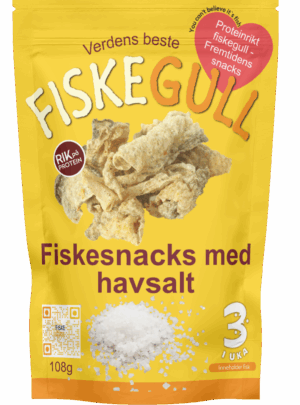
Fish Gold salmon skin contains approximately 40.3 g of protein per 100 g – still significantly more than traditional snacks such as potato chips (approximately 6 g/100 g) or cheese pops (approximately 7 g/100 g).
Why do different salmon skin products have different protein content?
It mainly depends on the production method:
- Air dried at low temperature: Retains more fat and moisture → lower protein percentage (40-50%)
- Deep fried or baked with oil: Adds extra fat → lower protein percentage
- Freeze-dried or hard-dried: Removes more water → higher protein percentage (70-80%)
Higher protein percentage does not necessarily mean a better product – it affects taste, texture, mouthfeel and nutritional composition.
Is collagen “real” protein?
Yes. Collagen is a structural protein that makes up the majority of the protein in salmon skin. It is made up of amino acids (the building blocks of protein) and counts as protein in the nutritional table.
What sets collagen apart from other proteins is its amino acid profile – collagen is particularly rich in glycine and proline. During digestion, collagen breaks down into amino acids in the same way as other protein sources.
How much protein do I get per serving?
It varies with portion size:
- Fish gold (30 g bag): ca. 12,1 g protein
- Typical 25 g bag (other brands): 10-20 g protein depending on product
For comparison:
- 1 boiled egg: about 6 g protein
- 1 slice of turkey (20 g): about 4 g protein
- 1 protein bar: 10-20 g protein (varies widely)
Is salmon skin a “complete protein”?
Yes. Fish contains all nine essential amino acids that the body cannot produce on its own. This makes salmon skin a complete protein source, on par with meat, eggs and dairy products.
Collagen does have a different amino acid profile than muscle protein (with less tryptophan), but it still provides all essential amino acids.
About nutrients
Does salmon skin contain omega-3?
Yes. Salmon skin contains omega-3 fatty acids (EPA and DHA) because the salmon stores them in the fatty tissue of the skin. The amount varies depending on the salmon's feed, farming method and season.
Fish Gold salmon skin has approximately 31.8 g of fat per 100 g, some of which is omega-3 fatty acids.
How much omega-3 do I get per serving?
Most manufacturers do not state precise omega-3 content because it varies naturally between individual salmon. Generally, you will get a few grams of omega-3 per 30g serving, but exact numbers require laboratory analysis.
For reference: 100 g of fresh salmon fillet typically contains 1-3 g of omega-3, depending on fat content.
Does salmon skin contain vitamins and minerals?
In smaller quantities than fresh fish. The drying process can reduce some vitamins (especially B vitamins), but minerals such as selenium, iodine and phosphorus are still present.
Salmon skin is eaten primarily for protein and omega-3 – not as a source of multivitamins.
How many calories does salmon skin have?
Fish gold salmon skin has approximately 450 kcal per 100 g, or approximately 135 kcal per 30 g serving.
For comparison:
- Potato chips: approx. 530 kcal/100 g
- Cheese pop: approx. 500 kcal/100 g
- Mandelsnacks: ca. 600 kcal/100 g
The difference lies in the composition: salmon skin has more protein and fewer carbohydrates than potato chips.
About preparation and origin
How is dried salmon skin made?
The process varies between manufacturers, but the main steps are:
- Purification: The skin is scraped to remove any remaining scales and removed from the salmon fillet.
- Cutting: Divide into snack sizes (approx. 5×5 cm)
- Seasoning: Add salt, or other flavors if desired.
- Drying/roasting: Removes water and makes the leather brittle
- Packing: Airtight packaging to preserve crispness
Fiskegul uses Norwegian salmon and Norwegian production.
Where does the salmon come from?
Fiskegul uses salmon skin from Norwegian farms. Norway is the world's largest producer of farmed salmon, with strict animal welfare requirements and environmental regulations.
Salmon skin can also come from wild-caught salmon, but most commercial salmon skin comes from farmed salmon because the volume is larger and the quality is more uniform.
Can you make salmon skin at home?
Yes, but it takes some work:
- Take care of the skin the next time you prepare salmon
- Rinse and dry the leather thoroughly.
- Place it on baking paper with the skin side down.
- Sprinkle with salt (and other spices if desired)
- Bake at 180°C for 15-20 minutes until crispy.
Homemade salmon skin is rarely as crispy as commercial products, but works as a snack or topping.
About taste and use
What does salmon skin taste like?
Flavors of salmon – salty, umami-rich and slightly fishy. The texture is crispy and crunchy, with a rich mouthfeel from the fat.
Some people find the taste to be “marine” or “exotic,” others “too fishy.” The taste experience depends on how accustomed you are to fish in general.
How do I use salmon skin?
As a snack:
- Straight from the bag between meals
- As a protein-rich alternative to chips on an evening out
In cooking:
- Crushed as a topping on salads
- Sprinkled over soups (especially Asian ones)
- As “croutons” in fish soups
- Crushed into cottage cheese/yogurt for protein and crunchy texture
Does it smell fishy?
Yes, but not strong. Dried salmon skin has a mild fishy smell – less than fresh raw salmon, but more than dried cod fillet. The smell disappears quickly after eating.
About health and allergies
Is salmon skin healthy?
Salmon skin is a protein source with omega-3 fatty acids and low in carbohydrates. It fits well in a varied diet, especially for those who want to reduce carbohydrate intake or increase protein intake.
It is not a “superfood” or miracle food, but a nutritious alternative to traditional snacks.
Can children eat salmon skin?
Yes, if the child does not have a fish allergy. Salmon skin is crispy and can be a way to introduce fish to children who do not like fish fillets.
Be aware of the salt content – some products are quite salty.
Is salmon skin suitable for pregnant women?
Yes. Norwegian farmed salmon has low levels of heavy metals compared to wild predatory fish. The Norwegian Directorate of Health recommends 300-450 g of fish per week during pregnancy, of which at least 200 g should be oily fish.
Salmon skin counts as oily fish and is safe for pregnant women to eat. The omega-3 fatty acids are important for fetal brain development.
Can you be allergic to salmon skin?
Yes. Fish allergy affects 1-2% of the population. If you are allergic to fish, you should not eat salmon skin.
Salmon skin does not contain gluten, milk or nuts (unless spices with allergens are added).
How much salt does salmon skin contain?
This varies between products. Check the nutritional label – some brands have 1-2 g of salt per 100 g, others up to 3-4 g.
Fish gold states the salt content on the packaging. A 30 g portion typically provides 0.3-1.2 g of salt depending on the product.
About the environment and sustainability
Is salmon skin sustainable?
Yes, in the sense that it utilizes a residual resource. Previously, salmon skin ended up in animal feed or was thrown away. Turning it into human food reduces food waste and increases the value of each salmon.
The sustainability of farmed salmon in general is more complex (feed, medication, escape) – but salmon skin itself is a good example of circular economy.
Is salmon skin expensive in relation to its nutritional value?
The price varies, but salmon skin snacks typically cost 80-150 NOK per 100 g.
For comparison:
- Protein bars: 60-120 kr/100 g
- Biltong/dried meat: 150-250 NOK/100 g
- Fresh salmon fillet: 150-250 NOK/kg
Salmon skins are more expensive than potato chips, but comparable to other protein-rich snacks.
Practical information
How long does salmon skin last?
Unopened: 6-12 months in dry packaging (check best before date) Opened: 1-2 weeks in airtight container at room temperature
Salmon skin that has absorbed moisture becomes tough and loses its crispiness – always store airtight.
Can you freeze salmon skin?
Yes, but it is rarely necessary as the shelf life is good unopened. Freezing may affect the texture slightly – it may become less crispy after thawing.
Where do I buy salmon skin?
Fiskegull selges via [nettbutikk/forhandlere]. Andre merker finnes i helsekostbutikker, noen matvarekjeder og nettbutikker med sportskost.
Is salmon skin suitable as dog food?
Yes. Many dog owners use dried fish skin as a training treat or chew bone. It is natural, high in protein and completely free of additives.
Some brands sell specific “pet treats” with salmon skin – these are often cheaper than the human food version.
Do you have more questions? Contact us at [email protected] or try the product yourself. [Lenke til Fiskegull]




 Norsk bokmål
  Deutsch
 Suomi
Suomi
 English (UK)
 香港中文
香港中文