Why is collagen so popular?
Collagen has become one of the most talked-about ingredients in health and beauty products in recent years. But what exactly is collagen, what does the research say about its effects, and why is it showing up in everything from skin creams to snacks?
What is collagen?
Collagen is a structural protein and the most abundant protein in the body. It is found in skin, tendons, cartilage, bones and connective tissue, giving these tissues strength and elasticity.
There are many types of collagen, but the most common are:
- Type I: Found in skin, tendons, bones and fish skin
- Type II: Found primarily in cartilage
- Type III: Found in skin and blood vessel walls
The body's collagen production naturally decreases with age. Research shows that this process begins as early as the age of 20-30 and increases with each decade.
What does the research say?
The collagen market is characterized by a lot of marketing and varying evidence. Here's a balanced picture of what the research actually says:
Skin health – somewhat documented
Some studies show that oral collagen supplementation may have positive effects on the skin:
Proksch et al. (2014) studied 69 women over 8 weeks with 2.5-5 g of collagen daily. The study showed some improvement in skin elasticity compared to placebo.
Bolke et al. (2019) found similar results in a larger study with 120 participants over 90 days.
Important caveat: Many studies are industry-funded, and the sample sizes are often small. The EFSA (European Food Safety Authority) has not approved health claims for collagen and skin health.
Joint health – limited documentation
Bello & Oesser (2006) summarized research on collagen hydrolysate and osteoarthritis and found moderate pain relief in some patients.
Shaw et al. (2017) studied collagen supplementation in athletes and found signs of positive effects on cartilage and tendons, but concluded that more research is needed.
Important caveat: The effects are not consistent across studies, and EFSA has not approved health claims for collagen and joint pain.
Bone health – promising but not established
Some studies indicate that collagen combined with calcium and vitamin D may help maintain bone mass, especially in older women. This is an active area of research, and it is too early to draw definitive conclusions.
What the research does NOT document
There are many claims circulating about collagen that are not sufficiently documented:
- “Collagen strengthens the intestinal mucosa” – insufficient documentation
- “Collagen improves sleep” – not documented
- “Collagen increases muscle mass” – not documented as better than other protein sources
Why does the body break down collagen into amino acids?
An important point often forgotten in marketing: The body breaks down all protein – including collagen – into amino acids during digestion. These amino acids are then used where the body needs them.
This means that collagen from food or supplements does not “go straight to the skin” or “straight to the joints.” The body uses the amino acids where they are needed most.
What the body actually needs to produce its own collagen:
- Adequate total protein intake
- Vitamin C (necessary for collagen synthesis)
- Zinc and copper (cofactors in collagen production)
Collagen from marine sources
A growing segment within the collagen market is marine collagen sources – especially from fish skin and bones.
Why fish skin?
Fish skin is mainly composed of Type I collagen. Salmon skin is a residual resource from the fishing industry that has traditionally been discarded or used for animal feed. Utilizing this raw material for human food is a good example of the circular economy.
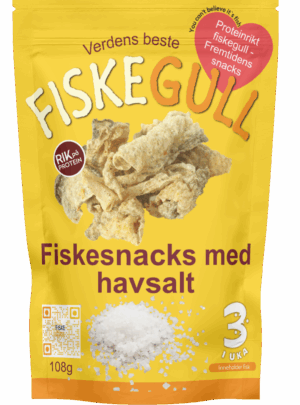
Fish gold is a Norwegian product made from crispy fried salmon skin. A 30 g serving provides 12.1 g of protein – including amino acids from collagen – combined with omega-3 fatty acids from the salmon.
Is fish collagen better than bovine collagen?
Both are Type I collagen with a similar amino acid profile. The body breaks both down into amino acids. There is no scientific consensus that one is better than the other.
Collagen and sustainability
An underestimated reason for collagen's popularity is its sustainability aspect. Fish skin and animal bones were previously waste – now they are utilized as valuable raw materials.
Norway With its extensive fishing industry, Norway has good conditions for producing marine collagen sources as part of a circular value chain.
Benefits of marine collagen production:
- Utilizes residual raw materials
- Reduces food waste
- Lower environmental impact than new production
Collagen in food vs. supplements
| Source | Collagen/protein | Practical |
|---|---|---|
| Bone broth (homemade) | Varies a lot | Time-consuming |
| Collagen powder (supplement) | 10-20 g per dose | Simple but expensive |
| Fish gold salmon skin (30g) | 12,1 g protein | Convenient snacks |
| Gelatin (10g) | Ca. 8,5 g protein | Limited use |
Brand: Studies documenting effects typically use 2.5-15 g of collagen daily. A snack can contribute to daily protein intake, but does not replace high-dose supplements for specific needs.
Who can benefit from collagen?
Based on available research, collagen supplements may be of interest for:
- People over 30-40 years old who want to support the body's natural collagen production
- Athletes which puts strain on tendons and joints
- Those who want to increase protein intake generally
Important: Collagen is not a panacea and is not documented as a medical treatment for any condition.
In summary
Collagen is popular because:
- It is the body's most abundant protein with important structural functions.
- Research indicates possible positive effects on skin and joints – but the effects are moderate and not consistent
- It is found in sustainable marine sources such as fish skin
- It is versatile and easy to consume (powder, snacks, broth)
Realistic expectation: Collagen is a good source of protein with promising – but not conclusively documented – health effects. Eat a varied diet, get enough protein in general, and ensure sufficient vitamin C to support the body's own collagen production.
Ready to test marine collagen sources?
Fiskegul salmon skin provides protein and omega-3 from Norwegian salmon – a practical and sustainable way to include marine nutrients in your everyday life.
Try Fish Gold here
Sources
- Proksch, E. et al. (2014)
“Oral supplementation of specific collagen peptides has beneficial effects on human skin physiology”
Skin Pharmacology and Physiology, 27(1), 47-55
https://pubmed.ncbi.nlm.nih.gov/23949208/ - Bolke, L. et al. (2019)
“A Collagen Supplement Improves Skin Hydration, Elasticity, Roughness, and Density”
Nutrients, 11(10), 2494
https://pubmed.ncbi.nlm.nih.gov/31627309/ - Bello, A.E. & Oesser, S. (2006)
“Collagen hydrolysate for the treatment of osteoarthritis and other joint disorders”
Current Medical Research and Opinion, 22(11), 2221-2232
https://pubmed.ncbi.nlm.nih.gov/17076983/ - Shaw, G. et al. (2017)
“Vitamin C-enriched gelatin supplementation before intermittent activity augments collagen synthesis”
American Journal of Clinical Nutrition, 105(1), 136-143
https://pubmed.ncbi.nlm.nih.gov/27852613/ - Ricard-Blum, S. (2011)
“The collagen family”
Cold Spring Harbor Perspectives in Biology, 3(1), a004978
https://pubmed.ncbi.nlm.nih.gov/21421911/ - Varani, J. et al. (2006)
“Decreased collagen production in chronologically aged skin”
American Journal of Pathology, 168(6), 1861-1868
https://pubmed.ncbi.nlm.nih.gov/16723701/ - EFSA – Health claims on collagen
No approved health claims for collagen and skin health in the EU
https://www.efsa.europa.eu/ - USDA FoodData Central
Nutritional data for comparing protein sources
https://fdc.nal.usda.gov/
Disclaimer: This article is not medical advice. Collagen is a food and dietary supplement, not a drug. For specific health concerns, please consult a doctor or clinical nutritionist.
-
Sale!

Fish gold fish snacks with Red Paprika 108gr.
kr 51,30 – kr 7180,00Price range: kr 51,30 through kr 7180,00 excl. VAT Select options This product has multiple variants. The options may be chosen on the product page -
Sale!

Fish gold fish snacks with cranberries 108gr.
kr 51,30 – kr 7180,00Price range: kr 51,30 through kr 7180,00 excl. VAT Select options This product has multiple variants. The options may be chosen on the product page -
Sale!

Fish gold fish snacks with sea salt 108gr.
kr 51,30 – kr 7180,00Price range: kr 51,30 through kr 7180,00 excl. VAT Select options This product has multiple variants. The options may be chosen on the product page -
Sale!

Fish gold fish snacks with Wasabi 108gr.
kr 51,30 – kr 7180,00Price range: kr 51,30 through kr 7180,00 excl. VAT Select options This product has multiple variants. The options may be chosen on the product page
FAQ: Why is collagen so popular?
1) Collagen Basics
What is collagen?
Collagen is a protein that is found naturally in the body and in animal products. It is part of the body's "building material" and is included in connective tissue, among other things.
Why is everyone talking about collagen right now?
Collagen has become popular because many people want simple everyday actions that fit into trends such as "protein", "beauty-from-within", active lifestyles and healthier snacks/supplements. In addition, social media and new product categories (powders, drinks, bars and snacks) have made collagen more visible.
Is collagen the same as gelatin?
They are related. Gelatin is heat-treated collagen that forms a jelly in food. Many collagen products are “hydrolyzed collagen” (collagen peptides), which are broken down into smaller pieces.
What does collagen peptides/hydrolyzed collagen mean?
This means that the collagen has been broken down into smaller protein pieces (peptides). It is often used in powders/supplements because it is easy to mix into liquids.
Is collagen found in regular food?
Yes. Collagen is found in animal products, especially in skin, cartilage and connective tissue. Many people associate it with stock, rind and products "with structure".
2) Marine collagen
What is meant by "marine collagen"?
It is often used to refer to collagen that comes from marine raw materials (such as fish). In practice, it refers to raw materials where collagen is naturally found.
Is “marine collagen” better than other types?
There are different preferences and product claims in the market, but "best" depends on what you are looking for (source of raw materials, taste, price, application, tolerance). For specific health effects, one must be careful with firm conclusions.
What is the benefit of using more of the fish?
Many people like the idea of better resource utilization: using more of the raw material can be perceived as more sustainable than throwing away by-products.
3) Health, effect and expectations (important)
Does collagen provide documented health benefits?
Research on collagen is often covered in the media, but effects can vary and depend on the type of product, dose, duration, and what is being measured. We recommend having realistic expectations and using collagen as part of a holistic diet.
Can you promise better skin, hair, nails or joints?
No, one should be careful about promising specific results. Health claims are regulated, and effects are individual.
How long does it take before you notice anything?
If you notice a difference at all, some report that it takes weeks. But there is no guarantee that you will notice anything.
Is collagen a dietary supplement?
Collagen can be both a food and a supplement, depending on the product. Fish meal is a snack/food item – not a dietary supplement.
What is the difference between collagen in food and collagen powder?
Powders are often standardized (collagen peptides) and are used for easy dosing. Foods may contain collagen naturally, but the amount and “form” vary.
4) Collagen and protein
Is collagen a “complete” protein?
Collagen has a different amino acid profile than many other protein sources. For most people, it is a good idea to have a variety of protein sources throughout the day.
Does collagen count as protein in the diet?
Collagen is a protein, but its quality and composition can vary. Always check the nutritional information on the product.
What does "protein-rich" mean in practice?
This means that the product has a high protein content per 100 g. Feel free to compare with other snacks and look at the portion size.
5) Collagen, low carb and keto
Does collagen fit into a low-carb diet?
Many people who eat low-carb like collagen products because they are often low in carbohydrates. Always check the nutritional content per 100 g and per serving.
Does collagen fit into keto?
It can, but keto is about the totality of your diet. Look at carbs per serving and what else you're eating that day.
6) Safety, allergens and who should be extra careful
Who should be cautious with collagen products?
If you have allergies, are pregnant/breastfeeding, take medication or have a medical condition, it is advisable to consult a healthcare professional if you are unsure.
Can you have allergic reactions?
Yes, depending on the source of the raw material. Marine products may be unsuitable for people with fish allergies. Always read allergen labels.
Does Fish Gold contain allergens?
Fish gold contains fish. Some varieties may also contain soy. Always check the packaging for updated allergen information.
Is Fiskegull gluten-free?
Fish gold is labeled gluten-free. Always read the packaging for up-to-date information.
7) Fish oil and “sea collagen”
Why does Fiskegull fit into a collagen article?
Fiskegull is made from salmon skin – a raw material where collagen is naturally found. This makes Fiskegull relevant when talking about “marine collagen” as part of food and snacks.
Is Fiskegull a collagen product?
Fish meal is primarily a snack. It is not marketed as a dietary supplement, and should not be used as a "substitute" for medical measures.
How much collagen is in Fish Gold?
The amount of collagen is not necessarily stated or standardized. If you need exact numbers, it must be documented through analysis.
Does Fish Gold contain omega-3?
Fish may contain omega-3 naturally, but the content in a finished product may vary. See the nutritional declaration and product information.
Is Fiskegull free of palm oil?
Yes, Fiskegull is palm oil-free.
Is Fiskegull without added sugar?
Fish gold is made without added sugar. Check the packaging for up-to-date information.
8) Purchase, use and storage
How do you eat Fish Gold?
Straight from the bag, or as a crunch on salad, bowls or on a snack plate.
How do I store Fish Gold after opening?
Close the bag tightly and store in a dry place. Moisture can make the snack less crispy.
Where can I buy Fish Gold?
You can find Fiskegull in the online store and at selected retailers. See fiskegull.no for an updated overview.
9) Common Misconceptions
"Collagen melts away in the stomach, so it doesn't work" - is that true?
Protein is broken down during digestion, but the body uses amino acids/peptides as building blocks. What this means in practice for perceived effects varies.
“More collagen is always better” – is that true?
Not necessarily. The balance of the diet and total protein intake is more important than maxing out one ingredient.
"Collagen is a miracle cure" – is that true?
No. It is wise to view collagen as a possible supplement in everyday life, not a guarantee of results.
10) Frequently asked questions (brief)
What's the easiest way to get started?
Start by looking at what you actually want: more protein in your daily routine, low-carb snacks, or a supplement. Then choose the product that suits you.
What should I look for when comparing collagen products?
Raw material source (marine/bovine, etc.)
Ingredients list and allergens
Taste and application
Price per serving
Whether the product is food or supplement
Can I combine Fish Gold with collagen powder?
Yes, many people combine different products in their daily lives. Just remember the overall diet and allergens.