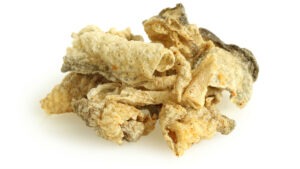
How to Crispy Fry Fish Skin – Complete Guide
Crispy fried fish skin has become a popular delicacy in both home kitchens and restaurants. With its crunchy texture, umami-rich flavor, and high protein and omega-3 content, it represents an exciting way to utilize whole fish.
In this guide, we'll go through everything you need to know to successfully make crispy fish skin at home – from which fish works best, to step-by-step preparation and different cooking methods.
Which fish skin works best?
Not all types of fish are equally suitable for deep-frying. Here are the best choices:
Fatty fish (best for deep-frying):
- Salmon: High fat content gives rich flavor and good crispiness. Most popular for home use.
- Trout: Similar properties to salmon, but slightly less fatty.
- Mackerel: Very fatty and flavorful, but may be a bit intense for some.
White fish (works, but less flavorful):
- Cod: Thinner skin, less fat. Gets crispy, but with less flavor.
- Halibut: Larger fish skin, thicker and more robust. Requires longer cooking time.
- Be: Cheaper alternative, but less attractive result.
Recommendation: Start with salmon skin. It is the easiest to work with and gives the best results for beginners.
Preparation – critical for success
Crispy fried fish skin requires careful preparation. Skip one step and the result will be tough or uneven.
Step 1: Remove all shells
Why: Shells become hard and unpleasant to eat, and provide an uneven texture.
How:
- Lay the skin flat on a cutting board with the shell side up.
- Use the back of a knife or a shell scraper
- Scrape against the “hairs” (towards the head of the fish) until all scales are gone.
- Check by running your finger over the leather – it should be smooth.
Step 2: Remove all fish meat
Why: Fish meat on the inside causes:
- Uneven crispiness (the meat becomes tough)
- Extra fat splashing into the oil
- Strong smell during cooking
How:
- Turn the skin with the flesh side up.
- Use a sharp knife or steel scraper
- Scrape away all the fish meat until you see clean skin.
- Wash the leather quickly under cold water.
Tips: For professional production (like Fiskegull) this is absolutely critical. For home use it is less important if you are pan frying, but still recommended.
Step 3: Dry thoroughly
Why: Water + hot oil = splash. The drier the leather, the better the result.
How:
- Place the leather between two layers of paper towels.
- Press gently to absorb moisture.
- Leave it for 5-10 minutes.
- Change the paper towel if it gets soaked.
Profi-tips: Some people place the leather in the refrigerator overnight for extra drying (but this is not necessary).
Cooking methods
Method 1: Deep frying (most authentic)
Equipment:
- Deep pot or deep fryer
- Meat thermometer (important!)
- Spatula or strainer
- Paper towels
Procedure:
- Heat the oil until 180°C (use thermometer)
- Cut the skin into approx. 5×5 cm pieces.
- Add 2-3 pieces to the oil (do not overcrowd)
- Bake in 5-10 seconds – the skin puffs up quickly
- Lift with spatula when golden
- Place on paper towels to drain grease.
Security:
- Use a deep pot (at least 10 cm deep) to avoid overcooking.
- Have a lid nearby in case the oil catches fire.
- Keep children and pets away.
- Do not let the oil exceed 190°C (fire hazard)
Which oil?
- Neutral oil with a high smoke point: rapeseed oil, soybean oil, sunflower oil
- Avoid olive oil (too low smoke point)
- Avoid butter (burns)
Method 2: Airfryer (healthier option)
Advantage: Uses minimal oil, easier and safer than deep frying.
Procedure:
- Brush the fish skin lightly with oil on both sides.
- Place in the air fryer without overlapping.
- Put on 200°C for 8-10 minutes
- Open and check after 5 minutes – stir if necessary.
- Continue until crispy and golden
Tips: Some air fryers run hotter than others. First time: check after 5 minutes to avoid burning.
Method 3: Pan-frying (easiest for beginners)
Advantage: Requires minimal equipment, good control.
Procedure:
- Heat a frying pan over medium-high heat.
- Add 1-2 tablespoons of oil
- Add the skin with leather side down
- Press it flat with a spatula (important! – otherwise it will curl)
- Bake in 3-4 minutes to crazy
- Turn and cook for 1 more minute on the meat side.
Obs: Pan frying rarely produces as crispy a result as deep frying, but is much easier.
Seasoning – when and how
When: Always AFTER frying. If you season before, the spices will burn and give a bitter taste.
Basic seasoning:
- Place the finished fried fish skin on paper towels.
- Sprinkle with coarse sea salt immediately (while it's hot)
- Add pepper, cayenne pepper or other spices to taste
Creative variations:
Fiskegull produces several flavor variants commercially:
- Sea salt: Classic and simple – highlights the natural umami of the fish
- Paprika: Sweet and mildly spicy
- Wasabi: Intense and sharp – perfect for sushi
- Cranberry: Sweet and sour contrast to the salty fish
- Egg Yolk (Limited Edition): Full-bodied and rich – popular in Asia
For home use, you can experiment with:
- Lemon zest + dill
- Lime + chili
- Sesame seeds + soy sauce (drip lightly over)
- Smoked paprika + garlic powder
Troubleshooting – what if something goes wrong?
Problem: The leather doesn't get brittle
- Cause: Too much humidity
- Solution: Dry it better next time, or let it air dry in the refrigerator.
Problem: The skin is burning
- Cause: Too high temperature
- Solution: Lower to 170-180°C (deep fryer) or 180°C (airfryer)
Problem: The skin wrinkles on the forehead
- Cause: Not pressed flat
- Solution: Use a spatula and press actively for the first 30 seconds.
Problem: Oil is spraying
- Cause: Fish meat or moisture left on the skin
- Solution: Scrape better and dry more thoroughly
Problem: Skins stick together in deep fryer
- Cause: Too many pieces in the oil at once
- Solution: Fry a maximum of 2-3 pieces at a time
Is crispy fried fish skin healthy?
Fish skin, especially from salmon, contains:
- Protein: 40-80 g per 100 g (depending on degree of drying)
- Omega-3 fatty acids: From the fish itself
- Collagen: Type 1 collagen from the skin
These nutrients are documented to be important for heart health, brain function and connective tissue.
Men:
- Deep frying adds extra fat and calories
- The type of oil affects the fatty acid composition
- Salting increases sodium content
Healthiest method: Airfryer with minimal oil, or pan-frying with rapeseed oil/olive oil.
Storage and shelf life
Freshly prepared:
- Eat immediately for best crispiness
- Stays crisp for 2-3 hours at room temperature
Storage:
- Airtight container at room temperature: 2-3 days (will become less crispy)
- Refrigerator: Not recommended (attracts moisture and becomes chewy)
- Freezer: Can be frozen, but loses crispiness – must be heated in oven (180°C for 5 min)
Reheating:
- Oven at 180°C for 3-5 minutes
- Airfryer at 180°C for 2-3 minutes
- Never microwave (will become chewy)
Areas of application
As a snack:
- Alone with a good dip (cottage cheese with herbs, avocado cream, soy-based dressing)
- As an alternative to chips on movie night
- Protein-rich snack after training
As a garnish:
- Crushed over soups (especially Asian noodle soups)
- Topping on salads for extra crunch
- Over rice dishes or poke bowls
As accessories:
- Served alongside fried fish
- As a "bread substitute" for fish soup
- Together with sashimi or sushi
From residual resource to gourmet product
Fish skin has historically been discarded or used for animal feed. In recent years, there has been a change, both in the home kitchen and in industry. Fish skin is one example of Norwegian production that has taken this residual resource and turned it into a finished product with different flavors.
The advantage of commercial products like Fish Gold:
- Consistent quality (cleaning and frying done professionally)
- Long shelf life (dry product in sealed bags)
- Practical when you don't have access to fresh fish skin
- Different flavors without extra work
The advantage of homemade:
- Full control over ingredients and oil
- Freshly prepared = most crispy
- Cheaper if you already have fish skin from other cooking
- Fun project in the kitchen
Conclusion
Crispy fried fish skin is a delicacy that combines taste, texture and nutrition. Whether you choose to make it yourself at home or buy ready-made varieties like Fiskegull, you get a product that is both protein-rich and versatile in use.
The key to success at home:
- Choose fatty fish (salmon is recommended)
- Remove all scales and fish meat.
- Dry thoroughly
- Use the correct temperature (180°C deep fryer, 200°C airfryer)
- Season after frying
Ready to test? Start with a small batch to find your favorite method. Once you master the technique, this is sure to become a favorite in the kitchen.
Want to skip the DIY process? Fiskegul salmon skin is available in stores and online stores all over Norway – perfect for those who want crispy fish skin without the work.
Sources and further reading
- Directorate of Health – Fish and seafood
Official recommendations on fish intake and omega-3
https://www.helsedirektoratet.no/faglige-rad/kostradene-og-naeringsstoffer/kostrad-for-befolkningen#fisk-sjomat-og-skjell - Seafood Norway – Sustainable use of fish
Information about side streams and residual resource utilization
https://sjomatnorge.no/ - The Danish Food Safety Authority – Safe cooking
Deep frying safety and oil temperatures
https://www.mattilsynet.no/mat-og-drikke/trygg-mat/i-hjemmet
-
Sale!

Fish gold fish snacks with Red Paprika 108gr.
kr 51,30 – kr 7180,00Price range: kr 51,30 through kr 7180,00 excl. VAT Select options This product has multiple variants. The options may be chosen on the product page -
Sale!

Fish gold fish snacks with cranberries 108gr.
kr 51,30 – kr 7180,00Price range: kr 51,30 through kr 7180,00 excl. VAT Select options This product has multiple variants. The options may be chosen on the product page -
Sale!

Fish gold fish snacks with sea salt 108gr.
kr 51,30 – kr 7180,00Price range: kr 51,30 through kr 7180,00 excl. VAT Select options This product has multiple variants. The options may be chosen on the product page -
Sale!

Fish gold fish snacks with Wasabi 108gr.
kr 51,30 – kr 7180,00Price range: kr 51,30 through kr 7180,00 excl. VAT Select options This product has multiple variants. The options may be chosen on the product page
FAQ: How to crisp fish skin
Generally
What does it mean to “crack” fish skin?
Crisping fish skin means heat treating the skin so that the moisture is driven out and the skin becomes light, crispy and “chip-like”.
What fish can I use?
You can crisp skin from several types of fish, but salmon skin is most commonly used because it is relatively thick, withstands heat well and gives a lot of flavor.
Does fish skin taste very “fishy”?
It varies with the ingredient and preparation. Good cleaning, proper drying and high enough heat often give a milder, more nutty and “umami” flavor.
Preparations
Do I have to remove the shells?
Yes, if the skin has scales, they should be removed. Scales can become hard and uncomfortable.
Do I have to remove fat and meat scraps?
Yes. Scrape off any meat scraps and excess fat. This will give a more even crispiness and reduce the risk of it becoming tough.
Should I rinse the leather?
Rinse quickly in cold water and dry thoroughly. Avoid soaking for long periods.
How dry does the skin need to be before frying?
As dry as possible on the surface. Dry with kitchen paper and leave the leather uncovered in the refrigerator for a while to “air dry”.
Preparation (frying pan / pot)
Which oil should I use?
A neutral oil that can withstand heat well (such as rapeseed or soybean oil). Choose an oil without a strong flavor.
What temperature is best?
High heat is important for crispiness. For deep frying/frying, a good range is often around 170–190°C. If the temperature is too low, the skin can become tough.
How long should fish skin be fried?
Usually a short time, often seconds to 1–2 minutes, depending on thickness and temperature. Take it out when it “puffs” and becomes crispy.
Should the leather be laid with the leather side up or down?
In deep frying it plays less of a role. In a pan it can help to start with the skin side down for even heat.
Can I use an air fryer?
Yes, but the results vary. The key is dry ingredients, a little oil and high temperature. Keep an eye on it so it doesn't burn.
Can I use the oven?
Yes, but it takes longer and is often less “puffed” than deep frying. Use high heat and preferably shake for air circulation.
Flavor and spices
When should I salt?
Salt and spices stick best right after roasting while the skin still has some surface fat.
Which spices are suitable?
Sea salt, pepper, chili, paprika, garlic, lemon pepper, seaweed/umami seasoning and (for those who like it) wasabi.
Can I make a sweet version?
Yes, but be careful that sugar can burn. If necessary, use sweetener or a light sprinkle after frying.
Common problems
Why does fish skin become tough?
Common causes are too low a temperature, too much moisture in the leather, or too thick pieces. Dry better and increase the temperature.
Why is it splashing so much?
Moisture causes spatter. Dry the leather well and use a pot with high sides. Do not overfill.
Why does it burn without becoming brittle?
The temperature may be too high, or the skin may have leftover marinade/sugar. Lower the temperature slightly and cook for a shorter time.
Why does it taste bitter?
This could be caused by burnt spices or too much heat over time. Cook for a shorter time and season afterwards.
Storage
How do I store crispy fried fish skin?
Let it cool completely and store in an airtight container. Moisture is the “enemy” of crispiness.
How long does it stay crispy?
Best the same day. In an airtight container it can stay crispy for 1–2 days, but it varies with the humidity in the room.
Can I stir it up again?
Yes. Heat quickly in an air fryer or oven on high heat for a few minutes.
Health and nutrition
Is fish skin rich in protein?
Yes, fish skin snacks are often high in protein. Check the nutrition label for exact numbers.
Does fish skin contain omega-3?
Fish (and especially salmon) contain omega-3. The amount in the finished snack varies with the raw material and processing.
Is fish skin suitable for low carb/keto?
It can fit into low carb and moderate keto, but depends on whether there is added starch/sugar and what the nutritional content is. Check carbohydrates per 100 g and per serving.
Allergens and safety
What allergens do I need to think about?
Fish is an allergen. If you use soy oil/soy lecithin or other ingredients, there may also be relevant allergens.
Is it safe to deep fry at home?
Yes, but be careful: use a stable pot, don't fill with too much oil, keep children away, and have a lid available. Don't use water to extinguish oil.
Fish gold
What is the difference between homemade crispy fried fish skin and Fish Gold?
Fish flakes are ready-made crispy snacks made for consistent quality, taste and consistency. Homemade can be very good, but varies more with ingredients, drying and temperature.
Does Fiskegull have palm oil?
No. Fish gold does not contain palm oil.
Where can I find ingredients and nutritional information for Fish Gold?
You can find it on the packaging and on the product pages at fiskegull.no.