This is a demo store for testing purposes — no orders shall be fulfilled. Dismiss
Skip to content
Fish skin is Norwegian salmon skin that is fried in soybean oil – not palm oil. The reason is simple: In a snack product where the frying oil plays a significant role in the fat composition, soybean oil provides significantly lower proportion of saturated fat than palm oil, while also performing very well technically (crispness, stability and neutral taste).
In this article, we briefly explain what soybean oil is, why the choice of oil matters in snacks – and why we believe soybean oil is a thoughtful choice when it comes to enjoying yourself.
Soybean oil is a vegetable oil extracted from soybeans (Glycine max). It is widely used in food production, including for deep frying, because it can be refined into a neutral oil which withstands heat well.
On an industrial scale, soybean oil in snacks is typically produced in three main steps:
Pressing
The beans are crushed and pressed mechanically to release the oil.
Solvent extraction
To extract the most oil possible, a solvent (often hexane) is often used to dissolve the fat in the pulp and increase the yield.
Refining – as Fiskegull uses
We use refined soybean oil in Fiskegull. The crude oil is industrially purified of unwanted substances, free fatty acids, odor and taste through processes such as neutralization, bleaching and deodorization.
Raw soybean oil has a strong flavor and lower smoke point. Refining removes these limitations, making the oil ideal for frying premium snacks like Fish Gold.
Refined soybean oil has a relatively high smoke point, typically around 230–235°C, which makes it well suited for deep-frying where the temperature is often around 160–180°C. Its neutral flavor means that it does not compete with the raw material or seasoning in products such as Fiskegull.
When we talk about “oil in snacks”, it is especially the proportion of saturated vs. unsaturated fat which is relevant. Fat can be roughly divided into:
Saturated fat
Monounsaturated fat
Polyunsaturated fats (including omega-6 and omega-3)
The Norwegian Directorate of Health and the WHO recommend replacing saturated fat with unsaturated fat where practical. In snacks, soybean oil reduces saturated fat by 68% compared to palm oil – a difference that counts when you eat often.
The numbers below are typical values from nutritional databases for refined oils (rounded):
| Oil type | Saturated fat | Monounsaturated fat | Polyunsaturated fat | Omega-6 | Omega-3 |
|---|---|---|---|---|---|
| Soybean oil | approx. 15–16 g | approx. 23 g | approx. 57–58 g | approx. 50 g | approx. 6–7 g |
| Palm oil | approx. 49 g | approx. 37 g | approx. 9 g | approx. 9 g | approx. 0.2 g |
| Sunflower oil | approx. 10 g | approx. 20 g | approx. 66 g | approx. 66 g | very little |
| Rapeseed oil | approx. 7–8 g | approx. 63 g | approx. 28 g | approx. 19 g | approx. 9 g |
| Corn oil | approx. 13 g | approx. 28 g | approx. 55 g | approx. 54 g | about 1 g |
Saturated fat
Palm oil is typically high in saturated fat compared to many other common frying oils. Soybean oil is typically significantly lower. For a snack product, this means that the oil choice can provide a noticeable difference in the proportion of fat that is saturated.
Unsaturated fat (monounsaturated + polyunsaturated)
Soybean oil is largely made up of unsaturated fats. This is an important part of why we believe soybean oil is a more thoughtful choice in snacks than oils/fats with a higher proportion of saturated fat.

The smoke point is the temperature at which the oil begins to smoke, break down and form undesirable compounds. In snack production, where the oil temperature is around 160–180°C over time, it is important that the oil can withstand heat well.
(Many people say 'boiling point', but for oil it is the smoke point that is the practical limit when frying and deep-frying.)
Typical smoke points for refined oils:
Soybean oil: around 230–235°C
Palm oil: around 230–235°C
Sunflower oil: around 225–230°C
Rapeseed oil (refined): around 200–230°C, depending on type
Corn oil: around 230–235°C
All of these are high enough for safe frying when the oil is properly treated. The differences in smoke point are less important than the differences in fatty acid composition when it comes to nutritional value. What matters most for the final product is therefore the type of fat (saturated vs. unsaturated), not just how high the oil can withstand heating.
Different snack categories have traditionally used different types of oil, both for technical, taste and cost reasons.
Common oils in potato-based snacks:
Sunflower oil – widely used, often in products that want to promote themselves with lower saturated fat content than palm oil-based alternatives.
Palm oil/palm fat – still used in many traditional snack products due to price, stability and texture.
Rapeseed oil – increasing use, especially in products that require a more "modern" fatty acid profile.
Blends – some manufacturers use blends, such as palm oil + rapeseed oil, to combine crispness, taste and price.
Pig rinds are often fried in:
Palm fat – very common, provides crispiness and a stable texture when fried repeatedly.
Animal fat (lard/beef tallow) – used in some products, often to give a more “authentic” taste.
Vegetable oils – sunflower oil or rapeseed oil can be used where you want to reduce animal fat or palm oil.
Fish snacks are a relatively new and growing segment. Typical oils:
Soybean oil – used in Fish Gold, among other things, precisely because of its combination of high heat resistance, neutral taste and lower saturated fat than palm oil.
Palm oil – used in many Asian and international fish snacks, often for price and processing reasons.
Sunflower and rapeseed oil – used by several Nordic and European manufacturers who want to avoid palm oil
When choosing oil for Fiskegull, we considered several factors: fat quality, taste, technical properties, availability and the environmental discussion surrounding different oils. Soybean oil was chosen as an overall compromise.
Palm oil contains around 49 g of saturated fat per 100 g, while soybean oil is around 15–16 g. This means that the proportion of saturated fat is significantly reduced when palm oil is replaced with soybean oil. In a product such as snacks, where the fat content is initially high, there is a clear advantage in having a higher proportion of unsaturated fat.
Soybean oil is about 81% unsaturated fat (monounsaturated + polyunsaturated). Palm oil is about half that, with close to 50% saturated fat. Snacks are not health foods, but when we first make a product with deep frying, we want the fat quality to be a notch better than in traditional palm oil-based alternatives.
Soybean oil is one of the few frying vegetable oils with a noticeable content of omega-3 (around 6–7 g per 100 g). The content is far lower than in fish or fish oil, but higher than in, for example, sunflower and corn oil, which contribute almost no omega-3. In Fiskegull, it is nevertheless the salmon skin that is the most important source of omega-3 (EPA and DHA).
Although there are certified and more sustainably produced varieties of palm oil, we wanted to completely avoid palm oil in Fiskegull. It's about both:
High in saturated fat
The ongoing environmental and sustainability debate surrounding palm oil production
Several major players in Norway have also chosen to reduce or eliminate palm oil in their own food products. For example, REMA 1000 has described that they have removed palm oil from many products as part of their responsibility and sustainability work. This shows that palm oil is an issue that many consumers care about – and it is one of the reasons why we have chosen soybean oil in Fiskegull.
Source: https://www.rema.no/ansvar/derfor-har-vi-fjernet-palmeolje-fra-matvarene-vare/
By choosing soybean oil, we avoid having to deal with palm oil's reputation, while at the same time getting an oil that works very well technically.
For us as a manufacturer, it is crucial that the oil works in practice:
High enough smoke point for stable frying
Neutral taste that lets the ingredient and spice dominate
Good crispness and durability in finished product
Soybean oil meets all these criteria. It is readily available on an industrial scale and provides the crispy, airy texture we want in Fish Gold.

| Product | Main raw material | Oil type | Main source of protein |
|---|---|---|---|
| Fish gold | Salmon skin | Soybean oil | Salmon skin (rich in collagen + marine omega-3) |
| Potato chips | Potato | Varies (often rapeseed, sunflower, palm) | Minimal (mainly starch) |
| Grisesvor | Griseskinn | Often palm fat/animal fat | Pigskin (rich in collagen) |
Salmon skin is typically composed of 70–90% collagen (type I), just like pork and beef skin. The difference is that fish collagen often has better bioavailability (1.5x more digestible) and lower molecular weight, which may be a unique advantage for Fiskegull.
Both salmon skin and pig skin are rich in collagen, but studies show that collagen from salmon has up to 1.5x higher digestibility and better absorption in the body than collagen from pork.

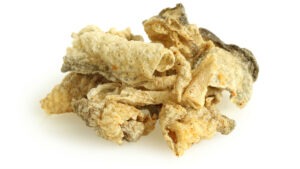
Fish gold is made from cleaned Norwegian salmon skin that is deep-fried into crispy, airy pieces before being seasoned. The product comes in several flavors, such as:
Cranberries
Salt
Wasabi
Paprika
Overall, we chose soybean oil because it:
Has lower saturated fat content than palm oil
Contributes more unsaturated fat
Contains some omega-3 (although salmon is the main source)
Has a high smoke point and neutral taste
Let's avoid the palm oil environmental and reputation discussion
Fish meal does not become "health food" for that reason - it is still a snack - but we believe the choice of oil makes the product more well thought out than if we had chosen palm oil or animal fat.



Which oil is most often used in chips and potato snacks?
It varies, but common choices include canola oil, sunflower oil, palm oil, corn oil, and soybean oil. Check the ingredient list to see what is used in the specific product.
Why do manufacturers use oil in snacks?
Oil provides crispness, carries flavor, affects mouthfeel and shelf life. It is a central part of the product, not just an ingredient detail.
What does “vegetable oil” mean on the ingredients list?
It means vegetable oil, but it can be one oil or a mixture. Check if the type is specified (e.g. “vegetable oil (soybean oil)”).
Is the choice of oil the most important factor in how “healthy” a snack is?
The choice of oil affects the fat composition, but the total (amount of snacks, salt, energy and the overall diet) also matters a lot.
Why is palm oil much discussed in snacks?
Because it has a higher proportion of saturated fat than many other vegetable oils (approximately 49 g per 100 g), and because palm oil production is controversial for environmental reasons.
Which oils typically have more saturated fat?
Palm oil (49.3 g per 100 g) and coconut oil have the highest percentage of saturated fat. Soybean oil (15.7 g), rapeseed oil (7.4 g) and sunflower oil (10.3 g) have significantly lower levels.
Which oils typically have more unsaturated fats?
Rapeseed oil, sunflower oil and soybean oil consist primarily of unsaturated fat (91%, 85% and 81% of total fat, respectively).
What is the difference between saturated and unsaturated fats in snacks?
Saturated and unsaturated fats describe the types of fat in the oil. The type of oil determines how much saturated fat the snack contains. Many dietary guidelines recommend limiting saturated fat.
What is soybean oil?
Soybean oil is a vegetable oil extracted from soybeans. It is widely used in food production and can be refined into a neutral oil that is well suited for deep frying.
Is soybean oil common in snacks?
Yes, soybean oil is used in many snacks because it is neutral in taste, works well in manufacturing, and has lower saturated fat than palm oil.
Does soybean oil contain omega-6 and omega-3?
Yes. Soybean oil contains both omega-6 and some omega-3 as part of the polyunsaturated fat.
Are omega-6 in soybean oil unhealthy?
Omega-6 (linoleic acid) is an essential fatty acid. Scientific reviews nuance the concern about inflammation, and the overall diet (including enough omega-3) is important.
Is soybean oil better than palm oil?
Soybean oil has significantly lower saturated fat (15.7 g vs. 49.3 g per 100 g) and contains omega-3, while palm oil does not. For snack production, soybean oil is a clearly better choice when the goal is to reduce saturated fat.
Why not use rapeseed oil instead of soybean oil?
Rapeseed oil has an even better fatty acid profile (7.4 g saturated fat, better omega-6/omega-3 ratio), but soybean oil is a good alternative that is more available in industrial production and has similar technical properties.
Does soybean oil contain protein?
No. Oil is 100% fat and contains no protein, carbohydrates or fiber. All the protein in Fish Gold comes from the salmon skin.
What is smoke point, and why is it important?
 Norsk bokmål Norsk bokmål
  Deutsch
  Suomi
Suomi  English (UK)
  香港中文 Norsk bokmål Norsk bokmål Deutsch
Suomi
English (UK)
香港中文
香港中文 Norsk bokmål Norsk bokmål Deutsch
Suomi
English (UK)
香港中文